
If you're considering buying a mobile home in California, you're probably trying to answer a few very practical questions first: Can I actually afford it? What will the monthly costs look like? Is it better to buy in a park or place a home on private land? What taxes and permits apply in California?
Those are the right questions. California can absolutely be a smart place to buy a manufactured home, but the numbers only work when you understand the full picture - not just the advertised home price.
At Homes Direct, we help buyers sort through that full picture every day: home selection, customization, financing, permits, site prep, and paperwork. If you are early in the process, it helps to start by browsing available manufactured home floor plans so you can compare sizes, layouts, and base pricing before diving into land and setup costs.
The short answer: is buying a mobile home in California worth it?
For many buyers, yes. A manufactured home can create a much more affordable path to homeownership than a traditional site-built house in many California markets. That is especially true for:
-
first-time buyers priced out of conventional homes
-
families who already own land
-
rural and suburban landowners adding a primary home or second dwelling
-
retirees looking to lower housing costs
-
buyers who want customization without custom site-built pricing
But the value depends heavily on where the home will sit and how complete your budget is.
A lower base home price can still turn into an expensive project if you underestimate:
-
land improvements
-
utility hookups
-
engineering and permits
-
transport and crane costs
-
foundation requirements
-
park space rent
-
local tax treatment
That is why the smartest buyers in California compare the all-in installed cost, not just the sticker price.
Mobile home vs manufactured home vs modular home in California
In everyday conversation, people still say "mobile home." But in California, the legal and practical differences matter.
Quick definitions
|
Term |
What it usually means |
Key California relevance |
|---|---|---|
|
Mobile home |
Often used casually for any factory-built home |
Technically, homes built before June 15, 1976 |
|
Manufactured home |
Factory-built home constructed to the federal HUD code |
The most common term for modern factory-built housing |
|
Modular home |
Factory-built in sections to state/local building code |
Often placed on permanent foundations and treated more like site-built homes |
According to California tax guidance, the term mobilehome is largely obsolete for property taxation purposes, and manufactured home is the current term used in law.
"Although they may generally have the same meaning, for California property taxation purposes, the term mobilehome is now obsolete and was changed to manufactured home." - California State Board of Equalization
For buyers, the main takeaway is simple: if you are shopping for a new home today, you are almost always buying a manufactured home or modular home, not a true pre-1976 mobile home.
The two main ways to buy in California
Most California buyers fall into one of these two paths:
-
Buy a home in a mobile home park
-
Buy a manufactured home for private land
Each path has different costs, financing options, and risks.
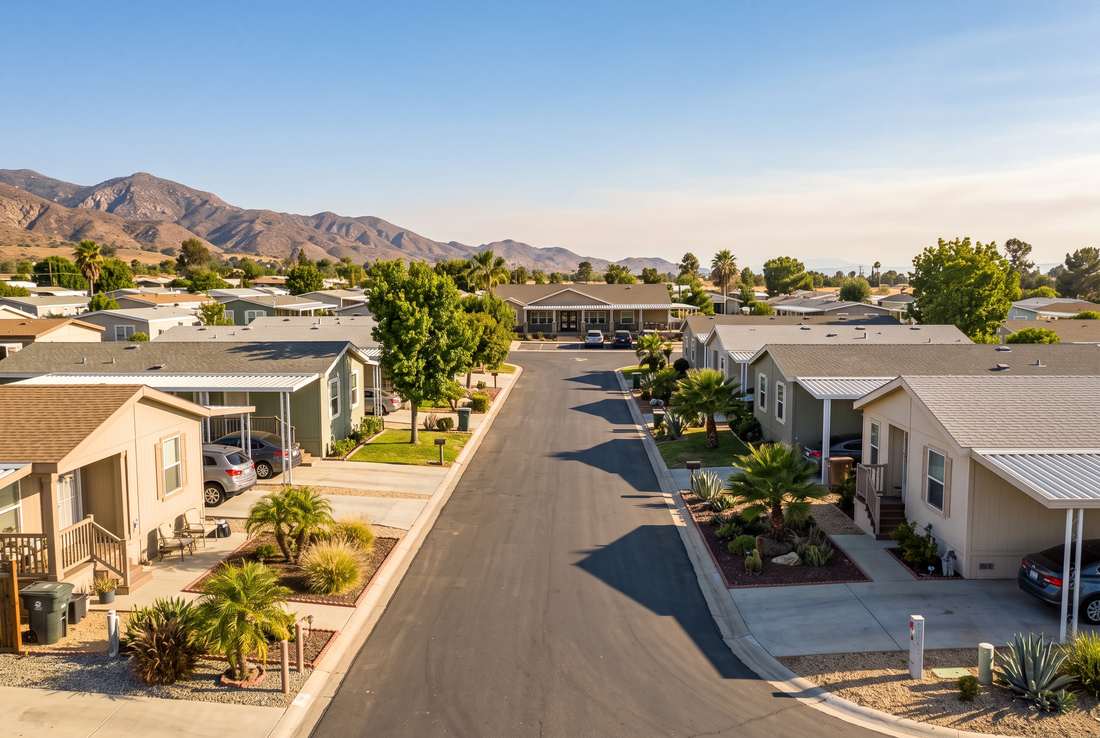
Option 1: buying in a park
This usually means you own the home but lease the space underneath it.
Best for:
-
lower initial entry cost
-
buyers who do not own land
-
age-qualified or lifestyle communities
-
buyers who want existing utility access and community amenities
Common California costs:
-
purchase price of the home
-
down payment
-
space rent
-
utilities
-
insurance
-
registration, taxes, or property tax depending on classification
-
park approval fees or rules
Main caution:
-
your monthly housing cost may stay lower than site-built housing, but space rent can rise over time
-
you must review park rules, age restrictions, pet rules, and resale conditions
Option 2: buying for private land
This usually means you own the home and the land, or you are purchasing both.
Best for:
-
buyers seeking long-term control
-
rural and suburban landowners
-
families wanting more privacy
-
buyers who want to add garages, porches, or larger site improvements
-
people comparing manufactured versus site-built home costs on owned land
Common California costs:
-
home price
-
grading and excavation
-
foundation
-
utility hookups
-
septic or sewer
-
well or water connection
-
electric service upgrades
-
permits and engineering
-
delivery and set
-
decks, skirting, driveways, steps, and porches
Main caution:
-
the home itself may be affordable, but site development in California can be expensive
Park home vs private land: which is better?
There is no universal winner. The better option depends on your budget, timeline, and how much control you want.
Side-by-side comparison
|
Factor |
Home in a Park |
Home on Private Land |
|---|---|---|
|
Upfront cost |
Often lower |
Usually higher |
|
Monthly predictability |
Includes space rent changes |
No space rent, but land-related costs |
|
Permitting complexity |
Often simpler |
Usually more complex |
|
Utility setup |
Often already in place |
May require major work |
|
Land ownership |
No |
Yes |
|
Long-term control |
Lower |
Higher |
|
Resale considerations |
Park approval may matter |
More flexibility |
|
Custom site additions |
More limited |
More flexible |
If you value the lowest initial hurdle, a park may make sense. If you want more permanence and control, private land often becomes the stronger long-term play.
How much down payment do you need in California?
This depends on the financing type, whether you own land, and whether the home is treated as real property or personal property.
Typical scenarios
|
Purchase type |
Common financing path |
Down payment expectation |
|---|---|---|
|
Home in a park |
Chattel/personal property loan or specialty lender |
Often higher than conventional mortgages |
|
Home + owned land |
Land-home loan, FHA/VA/USDA/conventional where eligible |
Can be lower depending on program |
|
Modular home on permanent foundation |
Mortgage-style financing |
Similar to other real estate loans, if qualified |
In plain terms:
-
park homes often require larger down payments
-
land-home packages may unlock better loan terms
-
credit score, debt-to-income ratio, land status, foundation type, and appraisal all affect terms
Many buyers start by assuming all manufactured home loans work like standard mortgages. In California, that is often not true.
That is why it helps to talk early with a team that understands both the home and the project. Homes Direct supports buyers through manufactured home financing as part of the larger planning process, not as a separate afterthought.
What monthly payment should you expect?
A California manufactured home payment is usually made up of several layers:
-
principal and interest
-
property tax or registration/in-lieu fees
-
homeowners insurance
-
land payment, if applicable
-
park space rent, if applicable
-
utilities
-
maintenance reserves
Example payment framework
|
Cost component |
Park home |
Private land home |
|---|---|---|
|
Loan payment |
Yes |
Yes |
|
Space rent |
Usually yes |
No |
|
Property tax or registration |
Usually yes in some form |
Usually yes |
|
Insurance |
Yes |
Yes |
|
Land loan or mortgage on land |
No |
Possible |
|
Septic/well maintenance |
Rare |
Possible |
|
HOA |
Sometimes |
Sometimes |
A home that looks cheaper on paper can become more expensive monthly if space rent is high. On the other hand, a home on land can start with a bigger monthly payment if you financed site work and utilities.
California taxes: what buyers miss most often
This is one of the biggest sources of confusion.
In California, manufactured homes are generally subject to:
-
sales tax or use tax at the time of sale or resale, and
-
either annual local property tax or an annual vehicle license fee/in-lieu fee, depending on how the home is classified
"Manufactured homes in California are generally subject to two taxes: sales tax or use tax at the time of sale or resale, and either the annual local property tax or the annual vehicle license fee, which is also called an in-lieu fee." - California State Board of Equalization
When is a manufactured home subject to property tax?
The answer depends on factors like:
-
when the home was first sold
-
whether it was converted to local property taxation
-
whether it is on an approved permanent foundation
-
whether it sits on owned land or leased land
For many newer homes, especially those purchased new on or after July 1, 1980, local property tax is the default.
What is the property tax rate?
California's general property tax rate is limited to 1% of assessed value, though local bonded indebtedness or voter-approved items can make the effective bill slightly higher.
What about the $7,000 homeowners' exemption?
If the home qualifies for local property taxation and is your principal residence, you may be eligible for the California Homeowners' Exemption, which reduces the taxable assessed value by $7,000. It is not a $7,000 cash refund; it is a reduction in assessed value for tax purposes.
Important practical takeaway
Before you buy, ask:
-
Will this home be taxed as local property tax or pay in-lieu fees?
-
Is it on a permanent foundation?
-
Is the land owned or leased?
-
Does it qualify for the homeowners' exemption?
-
Will there be supplemental taxes after purchase or new construction?
Those answers affect both your monthly payment and your long-term resale planning.
The extra California costs buyers often overlook
This is where many articles stay too generic. In California, the hidden costs can be the difference between a manageable project and a stressful one.
1. Delivery distance and transport conditions
Mountain roads, remote rural access, escort requirements, and route challenges can all increase transportation costs.
2. Foundation and engineering
Some sites require engineered foundation systems, soil-related design work, or additional structural details.
3. Utility connections
A low-cost rural parcel can become expensive fast if you need:
-
a new well
-
septic design and installation
-
trenching
-
power pole or transformer work
-
propane setup
4. Grading and drainage
Sloped lots, access roads, retaining needs, and drainage compliance can add major cost.
5. Permits and jurisdictional requirements
California is not one-size-fits-all. Counties and cities may differ on:
-
plan check
-
setbacks
-
fire requirements
-
foundation details
-
utility standards
-
impact or school fees in some jurisdictions
6. Park-specific expenses
For park homes, costs may include:
-
park approval
-
pet deposits or restrictions
-
age qualification issues
-
space rent escalations
-
community utility billing
7. Finishes and upgrades
Base pricing is helpful, but buyers often add:
-
upgraded kitchens
-
larger showers
-
energy-efficiency improvements
-
exterior packages
-
porches or carports
If you want to personalize your home, it is wise to review manufactured home customization options early so your budget reflects what you actually want to live in.
8. Insurance differences
Insurance costs can vary based on:
-
wildfire exposure
-
location
-
park requirements
-
foundation type
-
age and features of the home
9. Sales tax and title-related costs
Do not assume the online base price is your all-in final number. California buyers should confirm taxes, title handling, registration, and installation-related charges up front.

A realistic California budget framework
Here is a practical way to build your budget before you fall in love with a floor plan.
Budget checklist
|
Category |
Questions to ask |
|---|---|
|
Home base price |
What is included in the listed price? |
|
Upgrades |
Which options are must-haves vs nice-to-haves? |
|
Delivery |
How far is the home traveling and what route issues exist? |
|
Setup |
What are the set, level, tie-down, and finish costs? |
|
Foundation |
Pier and beam, permanent foundation, or engineered system? |
|
Site work |
Is grading, excavation, or drainage needed? |
|
Utilities |
Water, sewer/septic, electric, gas, internet? |
|
Permits |
Which county/city/HCD approvals apply? |
|
Taxes/fees |
Sales tax, property tax, registration, supplemental tax? |
|
Ongoing costs |
Space rent, insurance, maintenance, utilities? |
A strong buyer budget includes contingency, especially for private land installations.
Financing questions California buyers ask most
Can you get a mortgage on a manufactured home in California?
Sometimes, yes. But not every manufactured home purchase fits a standard mortgage structure.
You may have more mortgage-like options if:
-
the home is on owned land
-
it is installed on a permanent foundation
-
title and property classification support real-property lending
-
the borrower meets underwriting requirements
Are interest rates higher?
They can be, especially for homes in parks financed as personal property. Land-home loans may offer better structures than home-only loans, but every scenario is different.
Does land ownership help?
Usually yes. Owning land can expand financing options, improve long-term control, and help align the project more closely with traditional real estate lending.
Should you shop financing before choosing a home?
Ideally, you do both in parallel. The home, land status, county, and foundation plan all influence what financing works best.
Permits and approvals in California
This is the stage many buyers dread, but it becomes much easier when someone coordinates the process with you.
Depending on the project, you may need to address:
-
local zoning compatibility
-
setbacks and parcel suitability
-
HCD requirements
-
foundation plans
-
septic approval
-
well approval
-
grading permits
-
utility sign-offs
-
transport and installation coordination
For private land, the first question is not "Which model do I want?" It is often "Can this parcel support the home I want at a cost I can afford?"
That is why Homes Direct places so much emphasis on process. From planning and permits to site prep and paperwork, the goal is to prevent expensive surprises - not just sell a home.
Why customization matters more in California
California buyers often have highly specific needs:
-
multigenerational living
-
narrow or irregular lot constraints
-
climate-specific efficiency priorities
-
retirement-friendly layouts
-
rural utility realities
-
design standards for certain communities
A generic floor plan may not be the right answer. The strongest purchase is usually the one that matches your lot, your financing, and your long-term lifestyle.
At Homes Direct, buyers can choose from multiple manufacturers and a large mix of plans, then tailor the home with layout changes and finish upgrades where available. That flexibility is one reason so many buyers compare manufactured housing seriously against entry-level site-built options.
A practical step-by-step plan for buying a manufactured home in California
1. Decide where the home will go
Start with:
-
park or private land
-
county or city
-
access and utility reality
-
budget ceiling
2. Build the full budget
Do not stop at the home price. Include:
-
setup
-
permits
-
taxes
-
utility work
-
contingency
3. Narrow the right home type
Choose between:
-
single-wide, double-wide, or larger manufactured home
-
modular home if code or financing goals point that way
4. Get early financing guidance
Match the home and site plan to the financing path, not the other way around.
5. Verify site feasibility
Especially on private land, confirm:
-
zoning
-
setbacks
-
utilities
-
grading
-
foundation needs
6. Finalize customization and specifications
This is where you align the home with your actual lifestyle and resale goals.
7. Prepare permits, site work, and delivery
This phase determines whether the project stays on schedule and on budget.
8. Install, finish, and close out
Complete setup, utility connections, inspections, and final occupancy requirements.
Common mistakes to avoid
Focusing only on base price
A low advertised home price can be misleading without delivery, setup, and site work.
Underestimating park rules
Always read the park documents carefully before committing.
Buying land before checking home feasibility
Not every parcel is as build-ready as it looks.
Assuming taxes work like a standard house
California manufactured home tax treatment can differ significantly.
Waiting too long to ask financing questions
Loan options may affect the type of home and site you should pursue.
Choosing a dealer with limited support
A home purchase is only one piece of the project. Guidance through permits, site prep, and paperwork matters just as much.
Why many California buyers choose Homes Direct
California buyers need more than a catalog of floor plans. They need a partner who can help them navigate a complicated project with clarity.
Homes Direct stands out because buyers get:
-
a large selection of manufactured and modular homes from major builders
-
transparent online base pricing to support early comparison
-
factory-direct relationships that can improve access and value
-
support with planning, permits, financing, site prep, and paperwork
-
meaningful customization options, from finishes to more extensive design changes
-
multiple locations across California and the western U.S.
-
educational guidance that helps buyers make informed decisions
Whether you are comparing a park home, a land-home package, or a customizable modular solution, the goal is the same: make the process easier, clearer, and more manageable.
Final verdict
Buying a mobile home in California can be a very smart move - but only if you evaluate it as a complete housing project, not just a product purchase.
The best California buyers do three things well:
-
compare park living versus private land honestly
-
budget for the true installed cost
-
work with a team that understands the state-specific process
If you want expert help sorting through home models, financing questions, tax considerations, and setup realities, Homes Direct is built for exactly that. Explore homes, compare options, and connect with a team that can guide you from first questions to move-in. If you're ready for one-on-one help, start with the nearest Homes Direct location in California or reach out directly to discuss your project.
FAQ
Is it a good idea to buy a mobile home in California?
Yes, for many buyers it can be a practical and more affordable path to homeownership than a site-built house. The key is to evaluate the full installed cost, including land or space rent, permits, utilities, taxes, and setup - not just the home’s base price.
What is the downside of buying a mobile home?
The main downside is that buyers sometimes underestimate the extra costs, such as site prep, delivery, utility hookups, or ongoing park space rent. In California, the project can also involve more complexity around permits, taxes, and land readiness than many first-time buyers expect.
Do I pay property tax on a mobile home in California?
Often, yes - but it depends on how the home is classified. In California, manufactured homes are generally subject to either local property tax or an annual in-lieu license fee, and many newer homes are taxed locally as property.
What is the $7000 property tax exemption in California?
The Homeowners' Exemption reduces the assessed value of a qualifying principal residence by $7,000 for property tax purposes. It is not a $7,000 payment; it simply lowers the taxable value if your manufactured home qualifies for local property taxation and you live in it as your main home.
What is the difference between a mobile home and a manufactured home in California?
In common speech, people often use the terms interchangeably, but in California a mobile home usually refers to a factory-built home constructed before June 15, 1976. A manufactured home is a newer factory-built home constructed to the federal HUD code, which is what most buyers shopping today are considering.