
If you're trying to pin down modular home cost in 2026, you’ve probably noticed one frustrating pattern: the “price” of a modular home is almost never just one number.
A base home price can look surprisingly affordable at first glance. Then foundation work, delivery, permits, utility hookups, site prep, and upgrades start stacking onto the budget. For many buyers, especially first-time homebuyers and landowners in the western U.S., the real challenge is not finding a modular home they like. It’s understanding what the full project will actually cost before making a decision.
That’s where this guide helps. Below, we break down what goes into new modular home prices, what you can expect by size, which costs are easy to miss, and how to budget more confidently from factory order to move-in. At Homes Direct, this is exactly where guided support matters most: helping buyers compare models, understand transparent pricing, and plan for the full process, not just the sticker price on the home itself.
What competitor guides get right, and what they often miss
Most ranking articles cover three helpful basics:
-
modular homes usually cost less per square foot than many site-built homes
-
the base factory price is not the final move-in price
-
land, utility work, and permits can change the budget dramatically
But many stop short of answering the questions buyers actually ask, such as:
-
What does a realistic total price look like by home size?
-
How much should I budget for delivery and set?
-
Which upgrades move the cost the most?
-
When do modular homes remain a value, and when do site conditions erase the savings?
-
How do regional service and dealer support affect the final outcome?
This guide fills those gaps with a practical, buyer-first framework.
The Short Answer: How Much Does a Modular Home Cost in 2026?
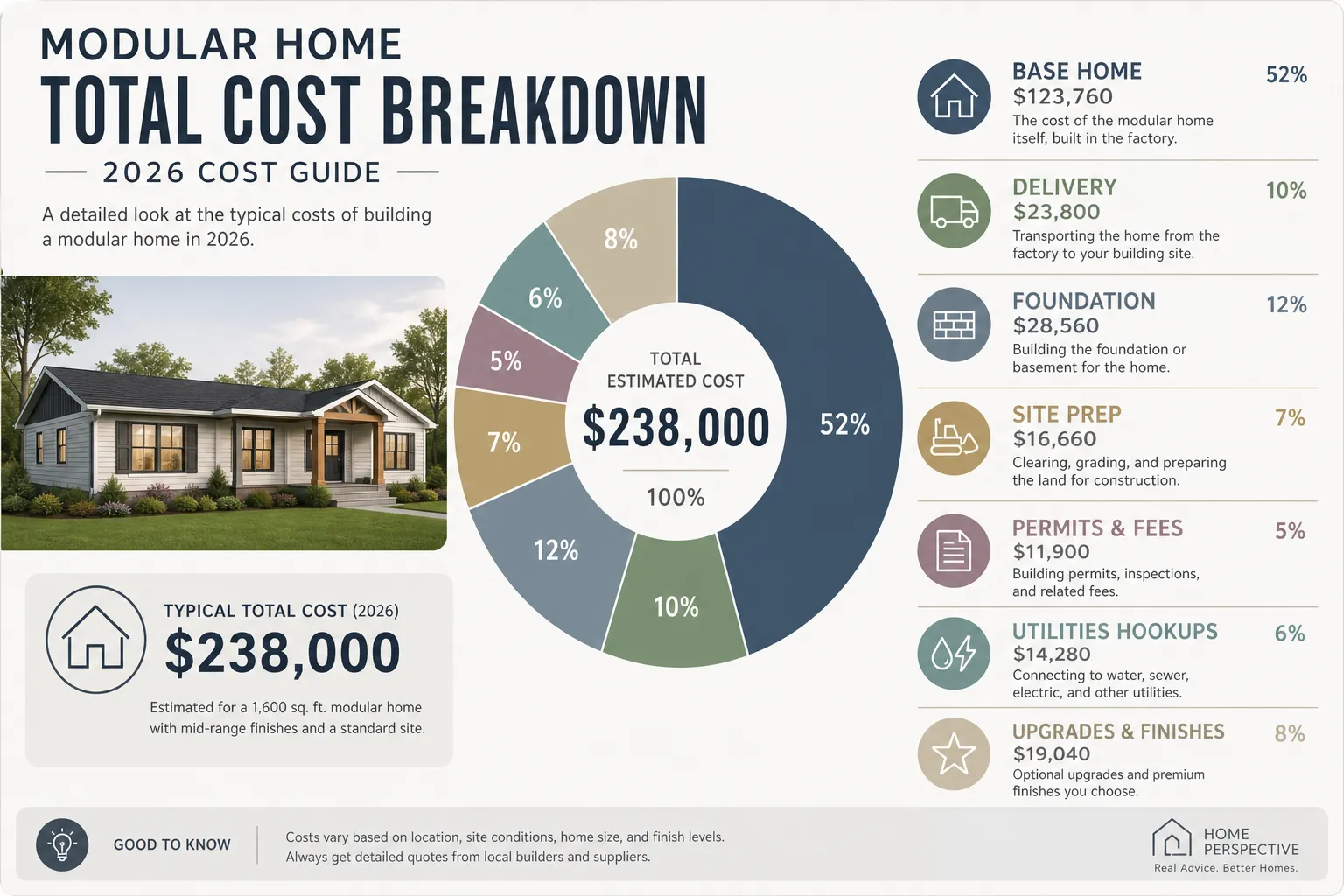
For 2026, a modular home often starts around $80 to $175 per square foot depending on size, design, region, finish level, and what is or isn’t included in the factory package.
That means a rough starting range looks like this:
|
Home Size |
Base Home Range |
Likely Total Project Range* |
|---|---|---|
|
1,000 sq. ft. |
$80,000–$175,000 |
$140,000–$260,000+ |
|
1,500 sq. ft. |
$120,000–$262,500 |
$190,000–$355,000+ |
|
2,000 sq. ft. |
$160,000–$350,000 |
$250,000–$470,000+ |
|
2,500 sq. ft. |
$200,000–$437,500 |
$310,000–$590,000+ |
*Total project cost usually includes foundation, delivery, set, site work, utility hookups, permits, and many common finishing items. Land is often separate.
That spread is wide on purpose. Buyers looking at modular homes and prices quickly discover that two homes with the same square footage can end up tens of thousands of dollars apart once site conditions and customization enter the picture.
Base Price vs. Real Project Cost
The most important pricing concept to understand is this:
Base modular home price
This usually covers the factory-built structure itself, including:
-
the home’s framing and sections
-
standard windows, doors, and roofing
-
basic interior finishes
-
standard cabinetry, flooring, and fixtures
-
the floor plan as ordered
Total modular project cost
This includes everything needed to make the home livable and legally occupiable:
-
engineering or plan review
-
permits and local fees
-
site clearing and grading
-
foundation
-
delivery and crane or set crew
-
utility trenching and hookups
-
septic or sewer connection
-
electrical service connection
-
decks, steps, skirting, or porches where needed
-
finish work at the marriage line and final interior/exterior completion
-
contingency for site surprises
This is why browsing a modular home price list without understanding what’s included can be misleading. A lower base price is useful, but it’s only one part of the budget.
A Simple Budget Rule That Actually Helps
A good planning shortcut is to assume the modular home itself may account for roughly 55% to 70% of the total non-land project cost, with the remainder going to site-related expenses and completion work.
That ratio shifts based on:
-
whether utilities already exist on the property
-
whether the lot is flat and accessible
-
how far the home must travel from the factory
-
whether you need a slab, crawlspace, or basement
-
how customized the home is
For buyers who want fewer surprises, this is where dealer guidance becomes valuable. Homes Direct helps customers move beyond rough averages by evaluating the actual property, floor plan, and scope of work early in the process.
Modular Home Cost Per Square Foot in 2026
Here’s a useful way to think about per-square-foot pricing.
Lower end: simpler plans, lighter site work
You’re more likely to land near the lower end if you choose:
-
a straightforward rectangular plan
-
standard finish selections
-
a property with existing utility access
-
easy delivery access
-
a simple foundation type
Higher end: custom design, harder site, more upgrades
You’ll move toward the higher end if you choose:
-
complex rooflines or multi-module layouts
-
premium kitchens and baths
-
long utility runs
-
difficult access for trucks or cranes
-
hillside, rural, or heavily improved lots
-
additional porches, garages, or structural changes
For shoppers comparing modular homes floor plans and prices, the key is to compare apples to apples. A 1,600-square-foot modular with standard finishes and easy site access is not equivalent to a 1,600-square-foot home with vaulted ceilings, upgraded siding, a large porch, and a sloped lot requiring extra prep.
Modular Home Cost by Size
Square footage questions dominate search because buyers want concrete examples. Here are realistic planning ranges.
1,000-square-foot modular home cost
A 1,000-square-foot modular home may fit:
-
2 bedrooms, 1 to 2 baths
-
a compact 3-bedroom layout
-
a small retirement, starter, or rural land home
|
Cost Category |
Estimated Range |
|---|---|
|
Base home |
$80,000–$175,000 |
|
Foundation |
$8,000–$35,000+ |
|
Delivery and set |
$8,000–$25,000+ |
|
Site prep and access |
$5,000–$30,000+ |
|
Utilities and permits |
$10,000–$40,000+ |
|
Estimated total |
$140,000–$260,000+ |
This size often delivers strong value because smaller homes can reduce both factory and finishing costs. It’s also a smart range for buyers comparing modular homes with ADU-style flexibility.
1,500-square-foot modular home cost
This is a popular sweet spot for:
-
first-time family homes
-
downsizers wanting more room than a compact layout
-
buyers who want 3 bedrooms and 2 bathrooms without oversizing
|
Cost Category |
Estimated Range |
|---|---|
|
Base home |
$120,000–$262,500 |
|
Foundation |
$12,000–$50,000+ |
|
Delivery and set |
$10,000–$30,000+ |
|
Site prep and access |
$8,000–$40,000+ |
|
Utilities and permits |
$15,000–$45,000+ |
|
Estimated total |
$190,000–$355,000+ |
2,000-square-foot modular home cost
This is one of the most commonly researched sizes because it works well for growing households and buyers who want extra living space.
|
Cost Category |
Estimated Range |
|---|---|
|
Base home |
$160,000–$350,000 |
|
Foundation |
$16,000–$70,000+ |
|
Delivery and set |
$12,000–$35,000+ |
|
Site prep and access |
$10,000–$50,000+ |
|
Utilities and permits |
$20,000–$55,000+ |
|
Estimated total |
$250,000–$470,000+ |
2,500-square-foot modular home cost
At this size, customization and structural complexity tend to matter more.
|
Cost Category |
Estimated Range |
|---|---|
|
Base home |
$200,000–$437,500 |
|
Foundation |
$20,000–$85,000+ |
|
Delivery and set |
$15,000–$40,000+ |
|
Site prep and access |
$12,000–$60,000+ |
|
Utilities and permits |
$20,000–$65,000+ |
|
Estimated total |
$310,000–$590,000+ |
Larger homes can still offer excellent value, but buyers should expect the budget to become more sensitive to upgrades, engineering, and site conditions.
What Delivery and Set Usually Cost
One of the most overlooked line items in modular pricing is delivery and installation.
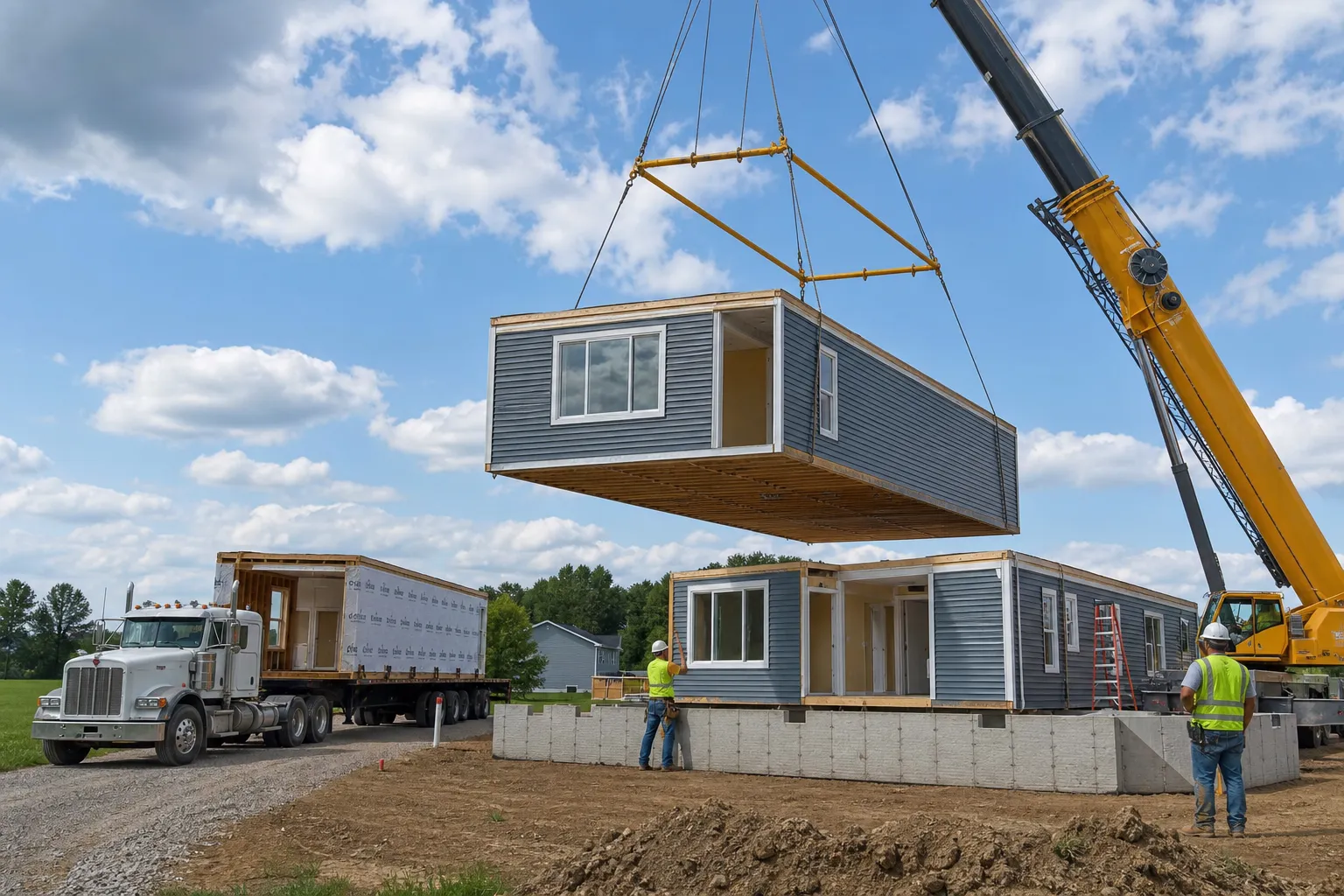
What “delivery and set” can include
-
transporting modules from the factory
-
pilot cars or route planning if required
-
crane rental
-
setting sections onto the foundation
-
fastening modules together
-
weatherproofing roof and exterior seams
-
finishing the marriage line
-
basic trim-out related to installation
Typical delivery and set factors
Costs vary based on:
-
distance from factory to site
-
number of modules
-
oversize load requirements
-
local labor rates
-
road access, slope, and crane placement
-
whether the site is rural, tight, or difficult to stage
A property with clear access and a simple drop can be much cheaper to set than a lot with steep grades, tree removal, or limited turning radius. This is one reason Homes Direct’s regional footprint matters. Working across multiple western states means the team has practical experience with the logistical realities that affect delivered cost.
Foundation Costs: Slab, Crawlspace, or Basement?
Your foundation choice can meaningfully change the budget.
Slab foundation
Usually the simplest and often least expensive option in many climates.
Best for: straightforward installs, milder climates, buyers seeking simpler total costs.
Crawlspace foundation
Common for modular homes and often a practical middle-ground.
Best for: buyers who want easier under-home access for mechanical systems.
Basement foundation
Usually the most expensive, but it can add storage or usable living space.
Best for: cold-weather areas, sloped sites, or buyers wanting significant extra space.
Foundation costs depend on:
-
soil conditions
-
engineering requirements
-
excavation depth
-
drainage and waterproofing needs
-
local code
-
concrete pricing in your area
If you’re early in the process, reviewing mobile home foundations types and requirements can help you understand how foundation decisions affect cost and installation planning.
The “Hidden” Costs Buyers Miss Most Often
Many competitor articles mention hidden costs, but they often do so too briefly. These are the line items that catch buyers off guard most often.
1. Site clearing and grading
If the lot has trees, brush, uneven terrain, poor drainage, or limited access, prep costs can escalate quickly.
2. Utility extension
The farther your home is from existing water, sewer, gas, or electrical service, the more trenching and hookup costs can rise.
3. Septic and well installation
On rural land, this can be one of the largest additional expenses.
4. Permit and jurisdiction fees
Permit costs vary dramatically by city, county, and state. Some areas may also require engineering review, energy compliance documentation, or added inspection steps.
5. Driveway and access work
Trucks and cranes need usable access. If they can’t reach the site safely, extra work is required before installation can happen.
6. Decks, steps, porches, and garages
These are commonly budgeted separately from the factory home price.
7. Upgrade creep
It’s easy to approve one upgrade at a time without realizing how quickly they add up in total.
If you want a deeper look at surprise line items across the buying process, see hidden costs of buying a manufactured home. Many of the same budgeting lessons also apply to modular projects.
Common Upgrades That Move the Price the Most
Customization is one of the strongest reasons buyers choose modular construction, but not all upgrades affect the budget equally.
Higher-impact upgrades
-
larger kitchens or expanded islands
-
premium cabinets and countertops
-
upgraded appliance packages
-
luxury primary bath layouts
-
vaulted ceilings
-
dormers and roofline changes
-
energy-efficiency packages
-
larger windows or upgraded exterior doors
-
attached garages or substantial porches
Lower-impact upgrades
-
paint and color selections
-
some fixture swaps
-
basic flooring upgrades
-
minor finish-level changes
Homes Direct stands out here because customization support goes beyond surface finishes. Buyers can often choose from layout adjustments, design upgrades, and in some cases more extensive floor plan changes depending on manufacturer and model. That makes it easier to align the home with your budget instead of settling for a one-size-fits-all approach.
Modular vs. Site-Built Cost in 2026
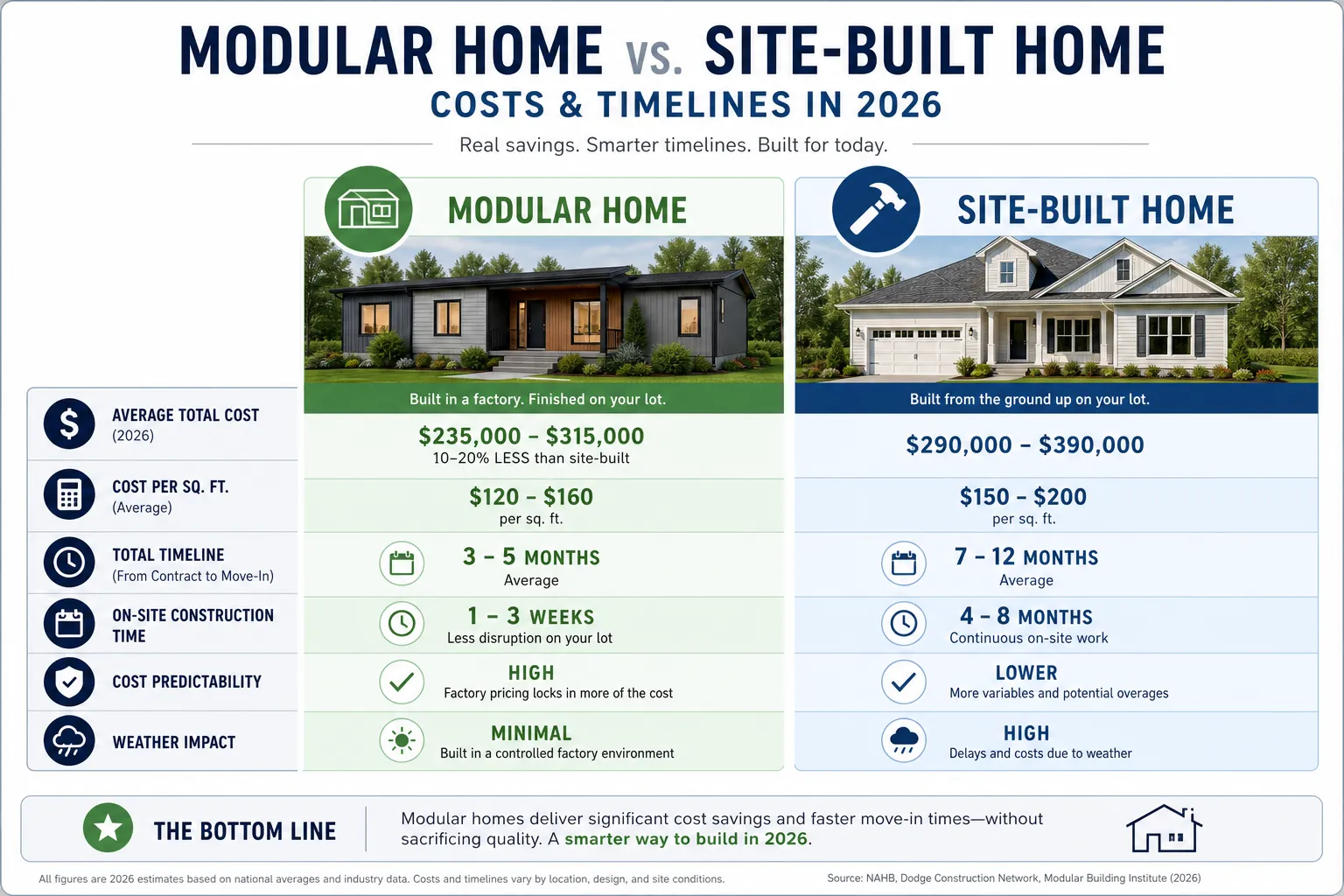
Many buyers researching modular home cost are really asking whether modular still beats site-built on value.
Typical comparison
|
Category |
Modular Home |
Site-Built Home |
|---|---|---|
|
Cost per sq. ft. |
Often lower to mid-range |
Often higher overall |
|
Build timeline |
Faster in many cases |
Usually longer |
|
Weather exposure during build |
Reduced |
Higher |
|
Design flexibility |
Strong, but plan-dependent |
Highest |
|
Site labor dependency |
Lower |
Higher |
|
Delivery logistics |
Yes |
No |
The honest answer
Modular is often more cost-effective, but not always dramatically cheaper.
It tends to perform best when:
-
the site is accessible
-
the plan is efficient
-
the buyer values shorter timelines
-
local site-built labor is expensive
-
the project is managed carefully from the start
It can lose some of that edge when:
-
delivery logistics are difficult
-
the lot requires major prep
-
the design becomes highly custom
-
local regulatory costs are unusually high
If you’re weighing the tradeoffs, modular vs stick-built homes is a useful next comparison.
Why Timing and Affordability Still Matter in 2026
Even when modular pricing rises, many buyers still turn to modular homes because they are trying to solve a bigger affordability problem.
"The price of a single-family home in 2024 was about five times the average household income." - The State of the Nation's Housing 2025
That gap is one reason buyers continue to compare alternatives to traditional site-built construction. A modular home may not be “cheap,” but it can still be a more manageable path to ownership when priced and planned correctly.
Why the Final Cost Varies So Much by Buyer
No two modular projects are exactly the same because cost depends on a full equation:
home design + finish level + site conditions + delivery logistics + jurisdiction requirements + financing structure
That’s why the same 1,800-square-foot model can be a smart value for one buyer and unexpectedly expensive for another.
Examples of variables that swing the budget
|
Variable |
Lower-Cost Scenario |
Higher-Cost Scenario |
|---|---|---|
|
Land condition |
flat, cleared lot |
sloped, wooded, rocky lot |
|
Utilities |
existing nearby services |
septic, well, long trench runs |
|
Delivery |
close to factory, easy roads |
long distance, difficult access |
|
Plan design |
simple footprint |
complex rooflines and add-ons |
|
Finish level |
standard package |
premium custom selections |
|
Local requirements |
simple permits |
intensive code and review process |
This is also why transparent pricing matters. Homes Direct helps buyers narrow from broad research phrases like “modular homes with prices” to an actual working budget tied to a specific home, manufacturer, location, and scope.
How Financing Affects What You Can Realistically Buy
Modular home affordability isn’t just about sticker price. It’s also about financing structure, monthly payment, down payment, and whether land and improvements are rolled together.
Buyers should understand:
-
whether land is already owned or being purchased
-
whether site improvements can be financed
-
how interest rate and down payment affect monthly budget
-
whether the lender is experienced with modular construction
-
what documentation is needed for appraisals, contracts, and draws
For many households, the “best” home is not the one with the lowest factory price. It’s the one with the best overall payment-to-value balance after all project costs are included. Homes Direct supports buyers through this stage as well, including planning and financing guidance that helps make the process feel more manageable instead of overwhelming.
How to Shop Smarter for Modular Homes and Prices
If you’re actively comparing floor plans, here’s the most practical way to do it.
Ask these questions before comparing models
-
What exactly is included in the base price?
-
Is delivery included?
-
Is set included?
-
What finish level is standard?
-
What local work is excluded?
-
What utility assumptions is the quote based on?
-
What customization options affect price most?
Compare using the same scope
The best quote is not always the lowest quote. It’s the quote with the clearest scope.
That means comparing:
-
same square footage
-
same finish assumptions
-
same foundation assumptions
-
same delivery area
-
same site-work exclusions or inclusions
A buyer who starts with a large, transparent inventory can usually make faster and better decisions. Homes Direct’s broad lineup from manufacturers such as Palm Harbor, Cavco, Karsten, Golden West, and Champion gives buyers more realistic options across styles, sizes, and budgets rather than forcing a fit from a narrow catalog.
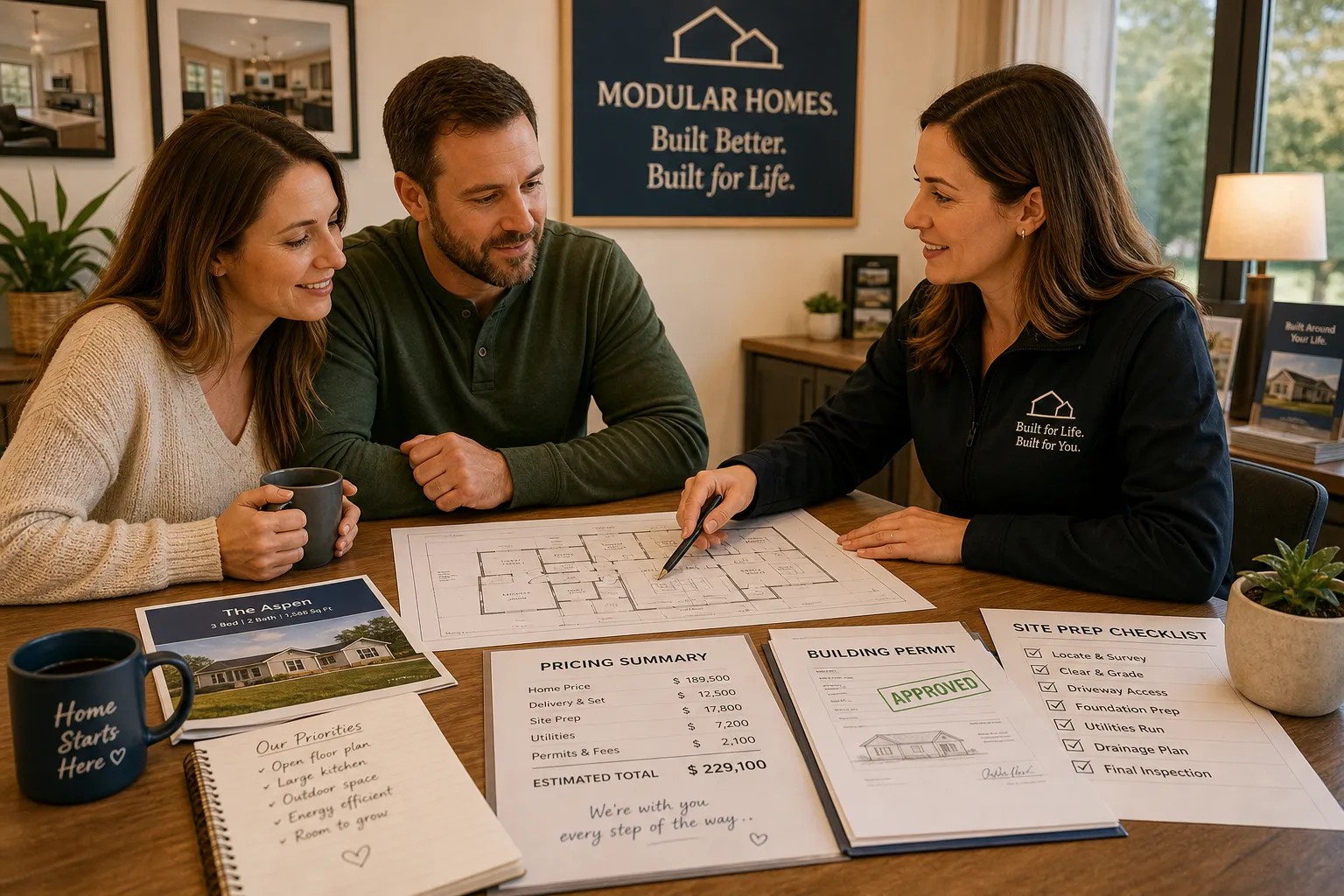
A Better Way to Estimate Your Real Modular Home Budget
Here’s a practical budgeting framework buyers can use before requesting final quotes.
Step 1: Estimate the home itself
Start with the floor plan and base price range.
Step 2: Add foundation and installation
Use your likely foundation type and delivery difficulty to estimate a realistic set budget.
Step 3: Add site and utility work
This is often where under-budgeting happens.
Step 4: Add permits and local fees
Always assume some variance here.
Step 5: Add upgrades intentionally
Separate must-haves from nice-to-haves.
Step 6: Add contingency
A contingency of 5% to 10% can protect you from common surprises.
Why Homes Direct Is a Strong Fit for Modular Buyers in the West
Buying a modular home is rarely just about picking a floor plan. It’s about coordinating land, planning, customization, financing, permits, setup, and paperwork without letting costs spin out of control.
That’s where Homes Direct brings meaningful value:
-
a large selection of modular and manufactured homes from top manufacturers
-
transparent pricing visibility on the website
-
strong coverage across the western U.S.
-
help with planning, permits, financing, and site prep
-
customization options ranging from finish changes to more significant plan adjustments
-
educational support that helps buyers make informed decisions
-
a customer-first process designed to simplify homeownership
If you’re still early in research, the Learning Center is a helpful place to keep building your understanding before narrowing down specific homes.
Final Takeaway
The real answer to “how much does a modular home cost in 2026?” is this:
The base home may start around $80 to $175 per square foot, but your total move-in-ready cost depends on the property, foundation, delivery logistics, utilities, permits, and upgrades. For many buyers, those non-home costs are the difference between a project that feels affordable on paper and one that is truly affordable in real life.
That doesn’t mean modular homes are a bad value. In many cases, they remain one of the most practical paths to homeownership, especially for buyers who want speed, flexibility, customization, and a more controlled construction process. The key is to work with a dealer who helps you price the whole project, not just the shell.
If you’re ready to compare real models, real layouts, and real pricing with expert support, Homes Direct can help you move from broad estimates to a plan you can actually act on.
FAQ
How much is a modular home in 2026?
In 2026, a modular home typically starts around $80 to $175 per square foot for the home itself, depending on design, finishes, and region. The full move-in-ready project cost is usually higher once you add foundation, delivery, permits, utility hookups, and site work.
Is it cheaper to build a house or get a modular?
A modular home is often more cost-effective than a comparable site-built house, especially when timelines and labor efficiency matter. However, difficult land, long utility runs, or expensive delivery logistics can reduce the savings.
Are housing prices predicted to go down in 2026?
There is no universal guarantee that housing prices will meaningfully fall in 2026, and affordability remains a major challenge in many markets. That uncertainty is one reason many buyers continue exploring modular homes as a more manageable path to ownership.
What does Dave Ramsey say about modular homes?
Dave Ramsey generally emphasizes buying a home you can truly afford and understanding the financing and resale implications before moving forward. In practice, that means a modular home can make sense if the total project cost, loan terms, and property fit your long-term budget.
What is the downside of modular homes?
The biggest downside is that the advertised home price is not the full project price. Buyers can underestimate site prep, permits, foundation, delivery, and utility costs if they focus only on the factory price.
What is the average lifespan of a modular home?
A well-built modular home placed on a proper permanent foundation can last as long as a traditional site-built home. Lifespan depends on construction quality, installation, maintenance, climate, and how well the home is cared for over time.