
If you’re planning to put a modular home on land, the financing can feel more complicated than the home itself. Buyers often ask whether they need a construction loan, a land-home loan, or a regular mortgage - and the answer usually depends on what stage the home is in, whether you already own the land, and how the lender structures the project.
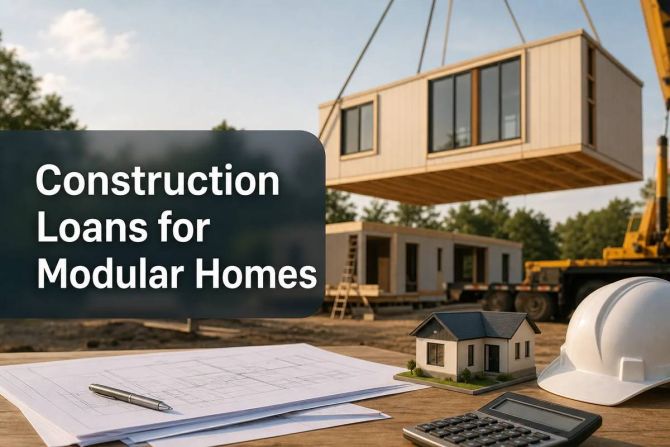
The good news is that modular homes are generally financed more like site-built homes than manufactured homes, especially when the home will be placed on a permanent foundation and treated as real property. The challenge is that the path to get there may involve more than one step.
At Homes Direct, we help buyers think through the full picture: choosing a home, understanding the land requirements, preparing for permits and site work, and connecting the financing pieces so the project feels manageable from day one. If you’re still comparing housing types, this guide to modular homes vs. manufactured homes vs. mobile homes can help clarify how financing often differs.
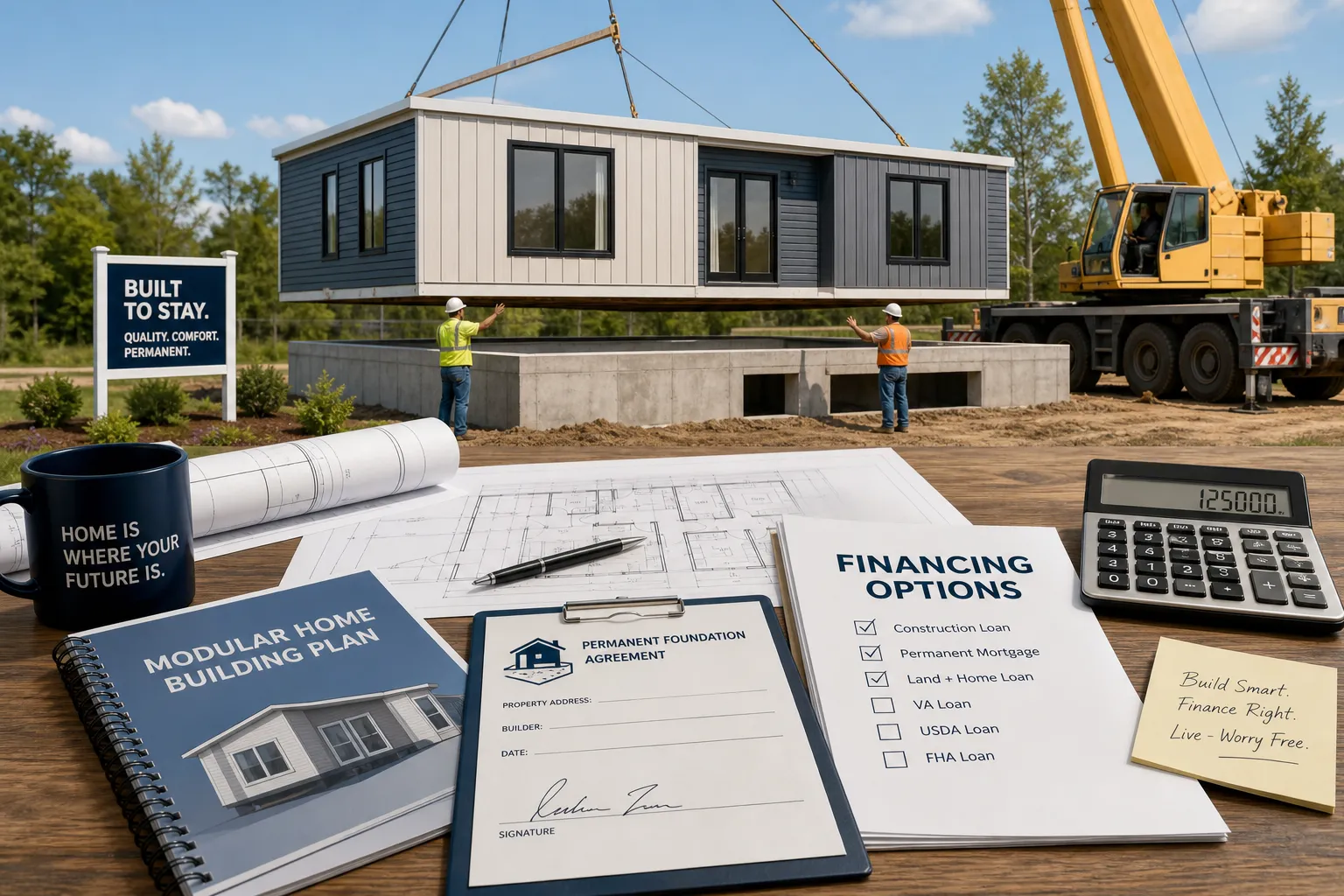
The short answer: which loan do you need?
In most modular home projects, the loan you need depends on the timeline.
You may need a construction loan if:
-
The home has not been completed yet
-
The land still needs site work, utility hookups, or foundation work
-
The lender will fund the project in stages or draws
-
You are combining land purchase and construction into one financing process
You may need a construction-to-permanent loan if:
-
You want one loan that starts during construction
-
The loan is designed to convert into a long-term mortgage after completion
-
You want to avoid having to close twice
You may need a land-home loan if:
-
The loan is structured to finance both the land and the home together
-
The home will be placed on land you are buying as part of the same transaction
-
The lender uses a bundled structure for the complete property
You may be able to use a standard mortgage if:
-
The modular home is already built and installed
-
The home is on a permanent foundation
-
The property is legally classified as real estate
-
The project no longer needs construction-stage funding
That’s why many buyers discover that “construction loans for modular homes” is really a question about project timing, not just home type.
Why modular homes are financed differently from manufactured homes
Modular homes are factory-built, but they are typically assembled on a permanent foundation and must meet applicable local or state building standards. That usually makes them easier to finance with traditional real-estate loan products once the home is complete.
By contrast, financing can be more restrictive when a home is not yet installed, when land improvements are unfinished, or when the transaction involves multiple moving parts such as land purchase, grading, septic, permits, and utility connections.
This is one reason planning matters so much. Homes Direct supports buyers through more than floor plan selection - we help customers across the western U.S. think through customization, site readiness, paperwork, and financing coordination so fewer surprises appear later in the process.
How a construction loan for a modular home usually works
A construction loan is designed to fund the building process before the home becomes a completed, mortgage-ready property.
Step 1: The lender reviews the full project
The lender typically wants to see:
-
The home contract or build specs
-
Land information
-
Site improvement estimates
-
Foundation plans
-
Utility plans
-
Permit-related details
-
Appraisal or projected completed value
-
Your income, assets, debts, and credit profile
Unlike a standard mortgage, the lender is not only evaluating you as a borrower. They are also evaluating the entire construction plan.
Step 2: Funds are released in stages
Instead of giving all the money upfront, many construction lenders release funds in draws tied to milestones. For example, funds may be released for:
-
Land purchase, if included
-
Foundation or site prep
-
Delivery and set
-
Utility installation
-
Final completion items
The exact draw schedule varies by lender and project structure.
Step 3: You may make interest-only payments during construction
During the build phase, borrowers often make payments only on the amount that has been disbursed so far, not necessarily on the full approved loan amount. This can help cash flow during construction, but it also means the payment structure may change once the home is complete.
Step 4: The loan is paid off or converted
At the end of construction, one of two things usually happens:
-
The construction loan is paid off by a permanent mortgage
-
The loan automatically converts into a standard mortgage if it was set up as construction-to-permanent financing
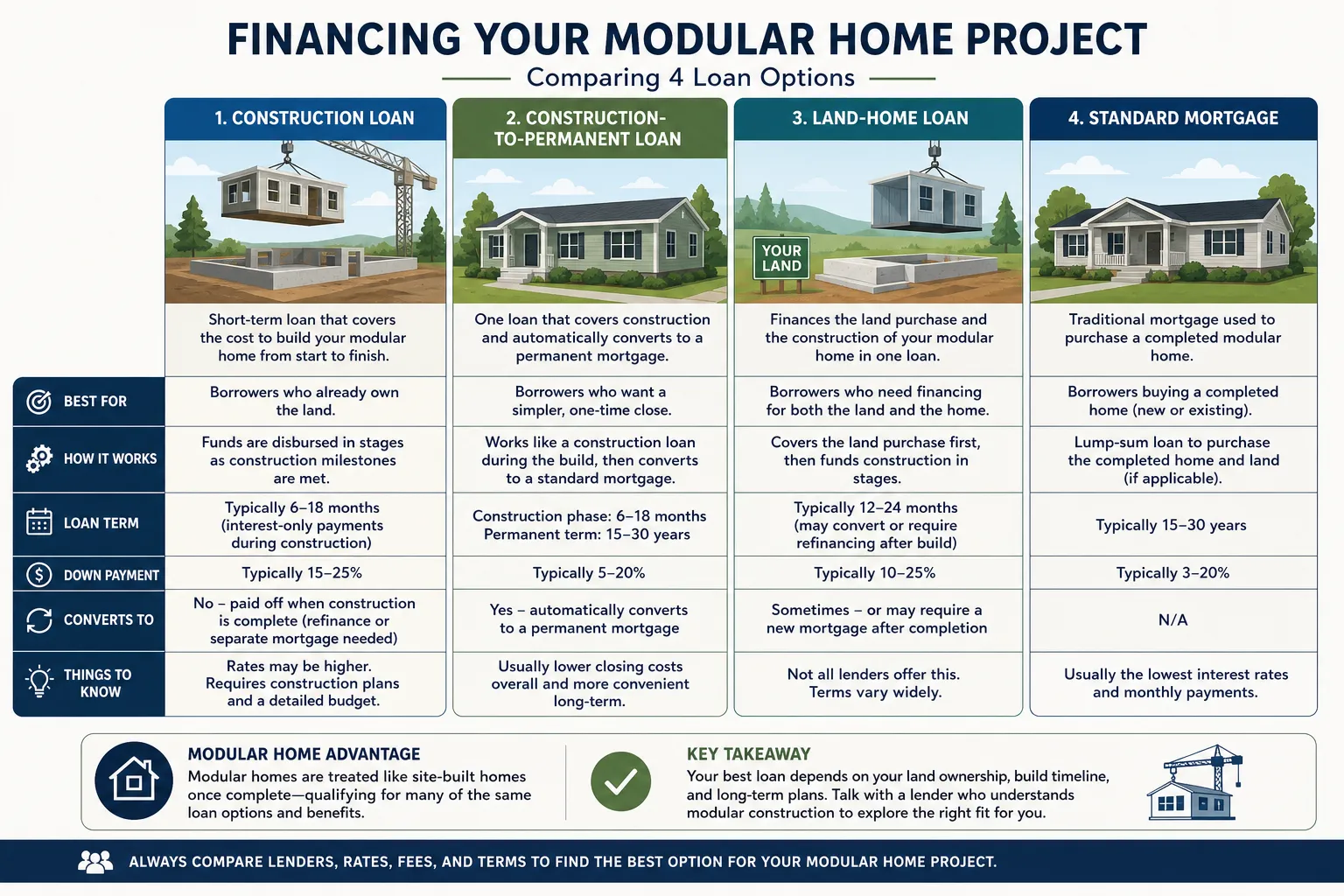
Construction loan vs. construction-to-permanent loan vs. land-home loan
Here’s the practical difference.
|
Loan type |
Best for |
How it works |
Main thing to know |
|---|---|---|---|
|
Construction loan |
Buyers funding a home before completion |
Short-term financing used during building |
Usually needs a second loan or payoff at completion |
|
Construction-to-permanent loan |
Buyers who want one financing path |
Starts as construction financing, then converts to a mortgage |
May reduce closing complexity |
|
Land-home loan |
Buyers financing land and home together |
Combines the land and home into one property-based structure |
Often depends on title, foundation, and lender rules |
|
Standard mortgage |
Buyers purchasing a completed modular home |
Traditional long-term home financing |
Usually only works after the home is fully installed and eligible |
When land ownership changes the process
Whether you already own the land can make a big difference.
If you already own the land
Owning the land may strengthen your file because:
-
The lender sees part of the project already secured
-
Your land equity may count toward the overall deal structure
-
You may need less borrowed money than someone buying land at the same time
If the land is owned free and clear, that can simplify parts of underwriting. If there is still a loan on the land, the lender will need to understand how that debt fits into the new financing.
If you are buying the land now
The project may be more complex because financing has to account for:
-
Land purchase price
-
Closing costs on the land
-
Site development before installation
-
The modular home itself
-
Contingency needs if costs shift
That does not mean the project is out of reach. It simply means the planning needs to be more complete upfront.
If the land is raw or undeveloped
Raw land can add steps that buyers sometimes underestimate, such as:
-
Surveying
-
Soil testing
-
Perc testing, where applicable
-
Driveway access
-
Tree clearing or grading
-
Well and septic planning
-
Electrical service setup
If you’re still evaluating lots, it helps to understand how to find the ideal land for your mobile home. While modular homes differ in code and financing, many of the land-readiness questions are similar.
Costs buyers should budget before the home is finished
One of the biggest content gaps in many financing articles is that they focus on the loan product but not the cash needs before final completion. In real life, modular home buyers often face costs that happen before the permanent mortgage begins.
Common pre-completion costs to budget for
Land-related costs
-
Purchase price of the lot
-
Land closing costs
-
Survey
-
Title work
Site preparation costs
-
Clearing and grading
-
Excavation
-
Driveway
-
Drainage work
-
Retaining walls, if needed
Utility and infrastructure costs
-
Water hookup or well
-
Sewer hookup or septic system
-
Electrical connection
-
Gas or propane setup
-
Internet or communications trenching in rural areas
Home installation costs
-
Foundation
-
Delivery
-
Crane or set crew, when required
-
Assembly and finishing work
-
Skirting or exterior completion items, if applicable
Government and professional costs
-
Permits
-
Engineering
-
Impact fees, if required locally
-
Inspections
-
Architectural or site plan review
Financing-related costs
-
Appraisal
-
Loan fees
-
Interest during construction
-
Builder’s risk or course-of-construction insurance, if required
-
Contingency reserves
A practical mistake is assuming the home price shown on a floor plan equals the all-in project price. Transparent pricing helps, but buyers still need a complete land-and-site budget. At Homes Direct, we work with customers on that broader planning process so the home selection fits the total project, not just the model price.
If you want a broader look at surprise expenses, this article on hidden costs of buying a manufactured home is useful context for site-built and factory-built projects alike.
What lenders usually require
Specific requirements vary, but most lenders review the same core areas.
Credit and borrowing profile
Lenders generally look at:
-
Credit history
-
Debt-to-income ratio
-
Stable income
-
Cash reserves
-
Overall financial strength
Construction loans often receive closer scrutiny than a standard purchase mortgage because the lender is taking on completion risk as well as borrower risk.
Down payment or equity contribution
Some borrowers put cash down. Others may contribute land equity, depending on the lender’s guidelines and how the land is valued. The exact amount varies widely, so it’s best not to assume a universal percentage applies in every state or every loan program.
Plans, contracts, and documentation
Expect to provide documents such as:
-
Purchase agreement for the home
-
Manufacturer specifications
-
Site bids and contractor estimates
-
Foundation details
-
Permits or permit status
-
Land deed or purchase contract
-
Insurance information
Appraisal based on completed value
For a modular home under construction, the appraisal is often based on the home’s projected value once finished, not just the value of the unfinished work at that moment.
Builder, dealer, and contractor coordination
Lenders usually want a clear picture of who is responsible for each part of the job:
-
Home manufacturer
-
Dealer
-
General contractor
-
Installer
-
Site prep contractor
-
Foundation contractor
That coordination matters. Homes Direct’s customer-focused process is built around helping buyers organize these moving parts, especially when customization, permitting, and land prep all intersect.
Common misconceptions about modular home financing
“A modular home always uses a normal mortgage.”
Not always. A standard mortgage may work well after completion, but the build phase often requires construction-stage financing.
“If I own land, I won’t need a construction loan.”
Owning land helps, but it does not automatically remove the need for construction financing if the home still has to be delivered, set, and completed.
“The loan covers everything automatically.”
Not necessarily. Some costs may need to be paid out of pocket, prepaid before reimbursement, or handled outside the main loan structure.
“The home price is the project price.”
Usually not. The land, site work, utility setup, permits, and finishing costs can materially change the total budget.
How to prepare before you apply
The smoothest projects usually begin with good pre-loan preparation.
1. Know your land situation
Do you own the lot, have it under contract, or still need to find one?
2. Choose a realistic home budget
Look beyond base price and think about your full installed cost.
3. Gather income and asset documentation
Construction lenders often require thorough documentation, so being organized helps.
4. Estimate site work early
Early bids for grading, foundation, septic, utilities, and access can prevent a budget mismatch later.
5. Understand customization impact
Layout changes, finish upgrades, and structural options can affect cost, timing, and financing documentation. Homes Direct offers extensive customization - from finish selections to more substantial floor plan adjustments - so buyers can align the home with both lifestyle needs and budget reality.
6. Leave room for contingency
Even well-planned projects can run into weather delays, permit timing shifts, or utility surprises.
Where buyers often get stuck
Many competitor articles explain the loan types but skip the emotional reality: buyers are often not confused about mortgages in general - they’re overwhelmed by the sequence.
A modular home project may involve:
-
Choosing the home
-
Confirming land suitability
-
Pricing site work
-
Reviewing lender options
-
Coordinating permits
-
Finalizing installation logistics
-
Moving from construction phase into permanent financing
That’s a lot for one household to manage alone. Homes Direct’s value is not just access to homes from trusted manufacturers - it’s helping buyers navigate the entire journey more clearly. With multiple locations across Washington, Oregon, California, Arizona, and New Mexico, plus service reach into additional western states, our team helps customers move from “Where do I even start?” to a practical, step-by-step plan.
Is a construction-to-permanent loan the simplest route?
For many buyers, it can be. A construction-to-permanent structure may reduce the need to refinance or re-close after the home is complete. But “simplest” doesn’t always mean “best” for every situation.
It may be a strong fit if:
-
You want a more streamlined process
-
The lender offers a program suited to modular construction
-
Your land, home specs, and site plan are already well defined
It may be less straightforward if:
-
The land situation is still unsettled
-
Site costs are still unknown
-
The lender requires more finalized documentation than you have today
That’s why early consultation matters. The best path often depends less on the home itself and more on how far along the project planning has progressed.
Final verdict: the right financing path depends on project stage, land, and planning
Construction loans for modular homes are not one-size-fits-all. Some buyers need short-term construction financing, some benefit from a construction-to-permanent setup, and others can move directly to a standard mortgage if the home is already complete and properly installed.
The key is to think of financing as part of the entire project - not a separate step at the end. Land ownership, site prep, utility access, permits, customization, and completion timelines all affect which loan structure makes the most sense.
Homes Direct is built to make that process easier. We offer a large selection of manufactured and modular homes from top manufacturers, transparent online pricing, broad western U.S. coverage, and hands-on support with planning, paperwork, customization, and next steps. If you want a clearer path from land to move-in day, explore our homes, financing resources, and guidance team to start building a modular home plan that actually works in the real world.
FAQ
How hard is it to get a construction loan for a modular home?
It can be more involved than getting a standard mortgage because the lender reviews both your finances and the full construction plan. Borrowers usually need solid documentation for the land, home, site work, budget, and contractors, but a well-prepared project can make the process much smoother.
What's the monthly payment on a $200,000 construction loan?
There is no single answer because the payment depends on the interest rate, draw schedule, loan term, and whether payments are interest-only during construction. Many borrowers pay only on the amount already disbursed while the home is being built, then move to a different payment structure after completion.
Do I need 20% down for a construction loan?
Not always. The amount required varies by lender, loan program, credit profile, and whether you already own the land. In some cases, land equity may help satisfy part of the borrower’s contribution, but you should confirm the exact requirement with the lender.
Can I get a $100,000 construction loan?
Possibly, but it depends on whether the lender offers loans at that size and whether the total project is feasible at that budget. The lender will still review the complete scope of the project, including land, site work, foundation, installation, and the projected completed value.
How much will I pay in monthly payments on a $100,000 loan?
The payment can vary significantly based on rate, term, and how the loan is structured. During construction, some loans require interest-only payments on disbursed funds, while after completion the payment may convert to a standard mortgage amount.
Is it cheaper to get a construction loan or mortgage?
A standard mortgage is usually simpler and often less costly to carry than a construction loan, but it generally works only after the modular home is finished and mortgage-eligible. Construction financing exists to cover the build phase, even though it may involve more fees, oversight, and moving parts.