

If you want to buy a home and the land it sits on at the same time, a manufactured home land package can make the process much more manageable. Instead of arranging separate purchases, separate approvals, and separate closing timelines, a land-home package combines the home, homesite, and often major setup costs into one coordinated project.
For many buyers, that matters because the real challenge is not just picking a floor plan. It is understanding the full picture: land, zoning, permits, foundation, utilities, delivery, installation, financing, and the true all-in cost. That is where buyers often get stuck.
Homes Direct helps customers work through that process every day across the western U.S., including everything from home selection and customization to financing guidance, planning, and site-readiness. If you are trying to decide whether to buy a manufactured home with land, this guide will walk you through what is usually included, how financing works, what can delay your timeline, and how to budget realistically.
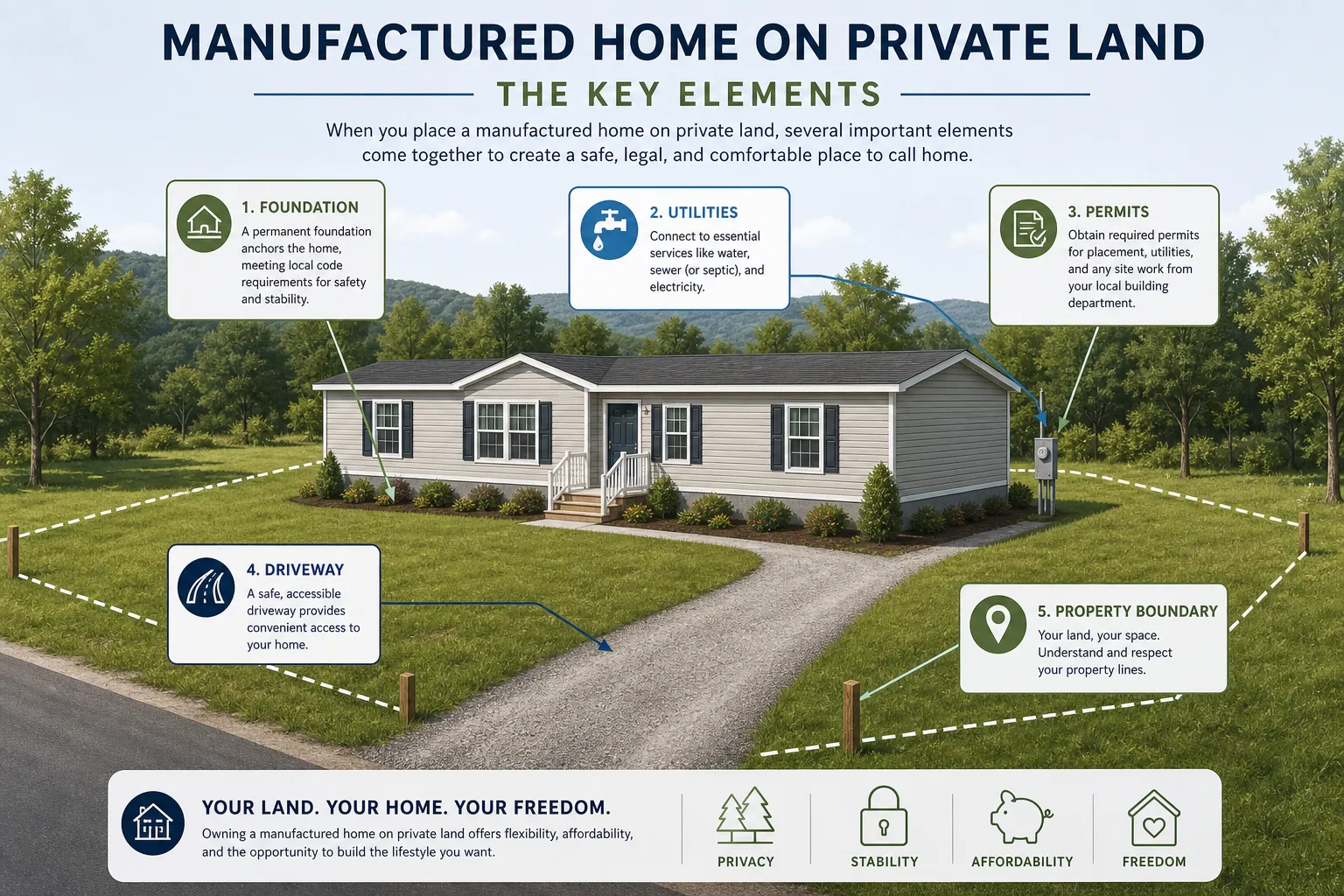
What is a manufactured home land package?
A manufactured home land package is a purchase structure that combines a new manufactured home and the land it will sit on into one overall transaction. Depending on the lender and project scope, it may also include site preparation and installation costs.
In practical terms, that often means one loan, one closing, and one monthly payment instead of trying to piece together:
-
a land purchase
-
a home purchase
-
separate setup contracts
-
separate utility and foundation bills
This structure is most common when the home will be placed on owned land and permanently installed according to lender and local requirements.
What it can include
Every package is a little different, but a manufactured home and land package may include:
-
The purchase price of the land
-
The manufactured or modular home
-
Delivery to the homesite
-
Foundation system
-
Installation and set
-
Utility hookups
-
Septic system or sewer connection
-
Well or water connection
-
Electrical service setup
-
Grading, excavation, and driveway work
-
Permits, engineering, and inspections
-
Skirting, steps, decks, or other required finish work
Some buyers assume “home and land package” automatically includes every development cost. That is not always true. One of the most important questions to ask upfront is: What is included in the quoted package price, and what is not?
Why buyers choose land-home packages
Land-home packages appeal to buyers who want more control than a leased-lot community offers, but still want a simpler path than managing every step separately.
Common reasons buyers prefer this route include:
-
They want to own the land beneath the home
-
They want one loan instead of multiple loans
-
They want the property treated more like real estate than personal property
-
They want long-term flexibility for resale, refinancing, or future improvements
-
They want a more affordable alternative to site-built construction
This is especially relevant for rural and suburban buyers, retirees downsizing to a simpler property, and families looking for an affordable path to homeownership without giving up space or customization.
If you are still comparing home types, it also helps to understand the differences between factory-built options. Homes Direct covers that in its guide to modular home vs manufactured home vs mobile home.
Manufactured home land package vs home-only purchase
The biggest difference is whether the land is part of the financing structure.
|
Feature |
Home-Only Purchase |
Land-Home Package |
|---|---|---|
|
Land included |
No |
Yes |
|
Loan structure |
Often personal property/chattel if not affixed |
Often real-property mortgage if eligible |
|
Monthly payments |
May involve multiple obligations |
Usually one combined payment |
|
Closing process |
Can be separate from land/site work |
More consolidated |
|
Equity building |
Home only |
Home and land |
|
Long-term flexibility |
More limited in some cases |
Often stronger |
If the home will be installed on leased land, financing often works differently than when you buy manufactured homes with land. That difference affects rates, loan terms, and eligibility.
How financing usually works when home and land are combined
In a typical land-home structure, the lender underwrites the project as a real-estate-secured transaction, provided the home and property meet program rules. That usually means the home must be installed on an approved permanent foundation and legally tied to the land.
Common loan options
The most common financing routes for manufactured home land packages include:
Conventional loans
These may work for qualified buyers with stronger credit profiles, sufficient down payment, and an eligible home and homesite.
FHA loans
FHA-backed financing can be useful for buyers seeking more flexible credit guidelines, though property and foundation requirements are still important.
VA loans
Eligible veterans and service members may be able to use VA financing for a manufactured home on land, subject to lender overlays and property standards.
USDA loans
For eligible rural areas, USDA loans can be attractive because of low down payment requirements, though location and household eligibility rules apply.
What lenders usually want to see
For a manufactured home on land to qualify for standard mortgage-style financing, lenders often look for:
-
Clear ownership or purchase contract for the land
-
Proper zoning for the home
-
Permanent foundation plans
-
Utility access and site feasibility
-
Home specifications and serial information
-
Installation plans and contractor documentation
-
Appraisal based on completed value
-
Permit pathway and local compliance
-
Borrower income, assets, credit, and debt-to-income review
Down payment expectations
Down payment requirements vary based on the loan type, credit profile, land equity, and whether site work is being financed. In some cases, if you already own the land, the equity in that land may help satisfy part of the required investment.
That is one reason land ownership can be such an advantage when structuring mobile home and land packages.
What “included in the loan” really means
Buyers often hear that they can finance “home and land together,” but the real question is whether the lender will also finance the soft and hard costs that turn raw land into a livable homesite.
Possible financeable costs may include:
-
Land payoff or purchase
-
Home base price
-
Transportation
-
Foundation
-
Installation
-
Utility trenching
-
Septic or well
-
Permits and engineering
-
Basic site improvements
But not every lender finances every line item. Some only include certain setup costs. Others may require bids from approved contractors, capped allowances, or completed plans before approving the final package amount.
This is why transparent budgeting matters. Homes Direct is especially helpful here because buyers can review home pricing online, compare models from multiple manufacturers, and work through planning details early rather than being surprised later.
If financing is a major concern, you may also want to review Homes Direct’s manufactured home financing process.
The full process: from raw land to move-in
A manufactured home and land package is not one purchase. It is a coordinated sequence of decisions and approvals.
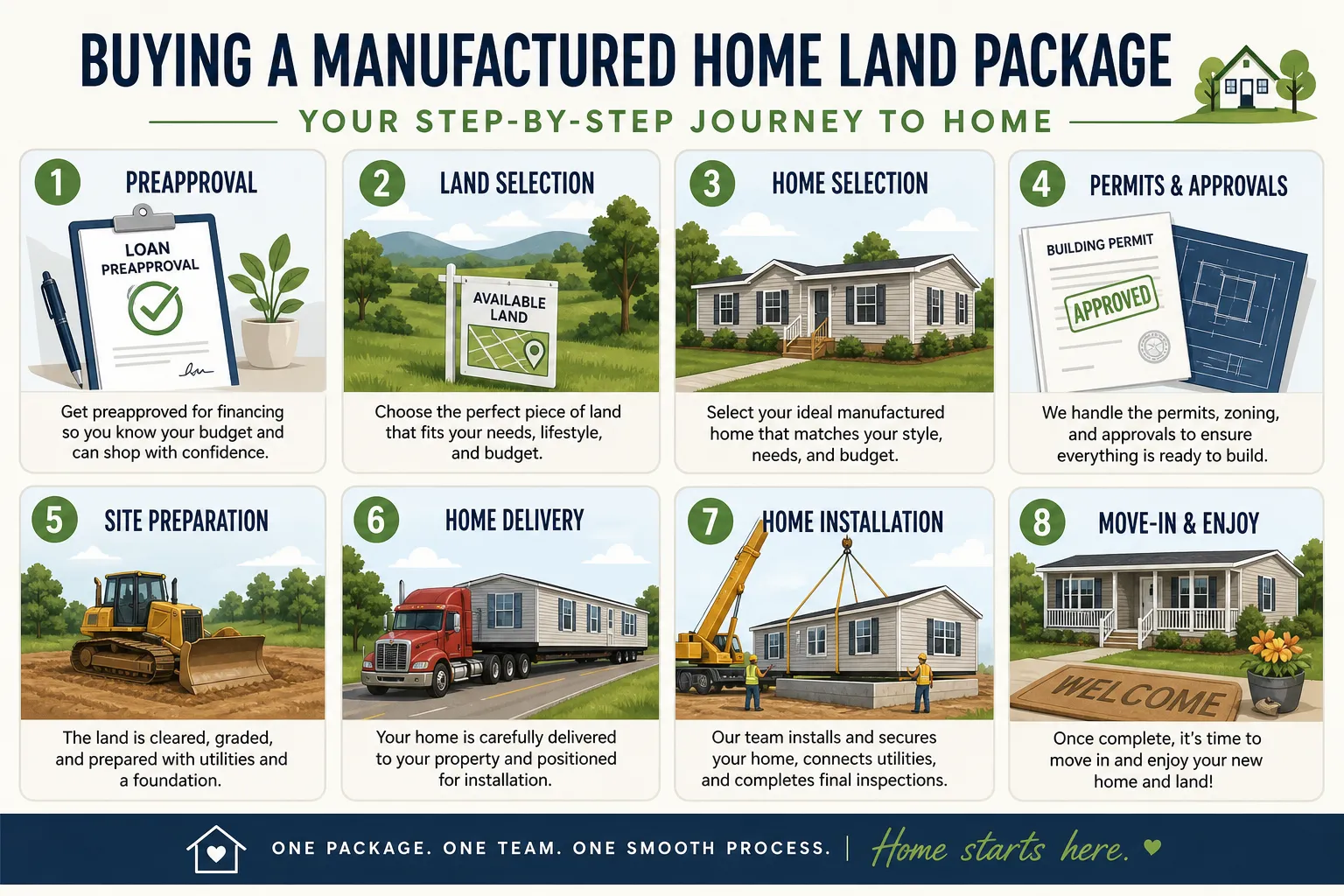
1. Get prequalified or preapproved
Before shopping seriously, understand your working budget. This helps you avoid falling in love with a home or parcel that does not fit your financing path.
At this stage, buyers should estimate:
-
Purchase budget
-
Monthly comfort level
-
Cash available for down payment and reserves
-
Credit profile
-
Whether land is already owned or still needs to be purchased
2. Choose the home
Next, choose the right floor plan and scope. This includes:
-
Size and bedroom count
-
Single-section or multi-section layout
-
Manufactured vs modular construction
-
Interior upgrades
-
Exterior options
-
Energy-efficiency features
-
Custom layout adjustments
Homes Direct’s strength here is selection. Because it works with multiple top manufacturers and offers broad customization, buyers are not locked into a narrow set of models. You can browse manufactured and modular homes and align the home with your budget, land constraints, and lifestyle needs.
3. Find and evaluate the land
This is where many deals either become workable or fall apart.
The lot needs to support not just the home, but the full installation plan. Important factors include:
-
Zoning and allowed home type
-
Minimum lot size rules
-
Setback requirements
-
Access for delivery trucks
-
Slope and grading needs
-
Soil conditions
-
Flood zone status
-
Utility access
-
Septic feasibility
-
Well depth or water access
-
Fire and safety requirements
A cheap parcel can become expensive fast if it needs extensive excavation, engineered foundation work, or long utility runs.
4. Confirm zoning, planning, and permits
Never assume a parcel allows a manufactured home just because it is residential land. County and city rules vary widely.
You may need approvals for:
-
Home placement
-
Foundation plan
-
Septic system
-
Well
-
Electrical service
-
Grading
-
Driveway or access permit
-
Floodplain compliance
-
Design review in some jurisdictions
This is one of the biggest content gaps in many articles: financing is only half the battle. Local approvals can determine whether the project is even possible on your preferred lot.
5. Prepare the site
Site prep is often the most underestimated part of the process and budget.
It may include:
-
Clearing brush or trees
-
Excavation and grading
-
Soil compaction
-
Foundation installation
-
Trenching for utilities
-
Septic installation
-
Well drilling
-
Driveway creation
-
Drainage improvements
-
Pads, retaining, or access work
These costs vary dramatically by location and topography. Flat land with nearby utilities is much easier than steep rural acreage with no services in place.
6. Finalize plans, bids, and lender package
The lender may require:
-
Signed land contract or proof of land ownership
-
Purchase order for the home
-
Site-work bids
-
Foundation plans
-
Permit status
-
Installation documents
-
Insurance details
-
Appraisal inputs
This is often when the final total project cost becomes clear.
7. Loan approval and closing
If approved, the loan closes based on the land-home package structure. Depending on the lender and transaction, funds may be disbursed in stages for land payoff, home purchase, and construction or setup work.
8. Delivery, installation, and finish work
After permits and site readiness are in place, the home is delivered, set, joined if multi-section, anchored, connected, inspected, and completed.
This phase may include:
-
Crane or set crew work
-
Marriage line completion
-
Skirting
-
Steps and landings
-
Utility tie-ins
-
Final inspections
-
Certificate of occupancy or local final approval
9. Move-in
Only after all final approvals and utility connections are complete is the home truly ready for occupancy.
What does a manufactured home land package cost?
There is no universal price because every project has three major variables:
-
Home cost
-
Land cost
-
Development/setup cost
Many competing articles mention home price and land price, but gloss over the third category. In reality, site development is often the swing factor that determines affordability.
Cost categories to budget for
|
Cost Category |
Typical Included in Package? |
Notes |
|---|---|---|
|
Home base price |
Usually |
Depends on model and factory options |
|
Upgrades/customization |
Sometimes |
Can increase quickly |
|
Land purchase |
Usually in a true package |
Not needed if you already own land |
|
Delivery |
Often |
Distance matters |
|
Foundation |
Often |
Required type varies |
|
Utility hookups |
Sometimes |
Electric, water, sewer/septic, gas |
|
Septic/well |
Sometimes |
Major rural cost category |
|
Permits/engineering |
Sometimes |
Easy to overlook |
|
Grading/access |
Sometimes |
Highly site-specific |
|
Taxes/insurance |
No |
Ongoing carrying costs |
|
Closing costs |
No |
Separate from construction expenses |
Why two similar homes can have very different total prices
A buyer might compare two similar homes and wonder why one “package” is far more expensive. Usually the difference is not the house itself. It is the land and site work.
For example:
-
Parcel A is flat, legal, and has utilities at the road
-
Parcel B is steep, rural, and needs septic, well, grading, and long trenching runs
Those are very different projects, even with the same floor plan.
Biggest cost surprises buyers miss
Here are the expenses most likely to be underestimated:
Utility extension
Power, water, gas, and telecom connections can cost much more when the homesite sits far back from the road.
Septic and well
In rural areas, these can become major line items and sometimes require engineering or multiple tests.
Foundation upgrades
Not every site works with a basic setup. Soil, frost depth, slope, and lender rules can change the design.
Permit and impact fees
Local jurisdictions may charge plan review, inspection, school, road, or development-related fees.
Delivery access work
Tight turns, trees, soft ground, or long driveways can require extra preparation before the home can be delivered.
Customization creep
It is easy to add nicer finishes, layout changes, porches, and appliance upgrades. These can be worthwhile, but they need to be tracked carefully.
Timeline: how long does it really take?
Buyers often ask how fast they can move into a new mobile home with land for sale type of project. The answer depends less on the factory build alone and more on land readiness and local approvals.
Typical phases
|
Phase |
Approximate Time |
|---|---|
|
Preapproval and budgeting |
1 to 2 weeks |
|
Home selection and land due diligence |
2 to 6 weeks |
|
Permits, engineering, and approvals |
3 to 12+ weeks |
|
Factory build |
6 to 16+ weeks |
|
Site prep and utility work |
2 to 10+ weeks |
|
Delivery, set, and final completion |
1 to 4 weeks |
What causes delays
The most common delays include:
-
Permit backlogs
-
Zoning conflicts
-
Incomplete site plans
-
Utility scheduling
-
Septic or well approval issues
-
Weather
-
Land access issues
-
Change orders after plans are submitted
The smoothest projects are the ones where buyers, dealer, lender, and site contractors coordinate early.
Land-home package vs buying in a community
Not every buyer needs land.
If you are considering mobile homes communities near me or comparing land ownership against placement in a land-lease community, the right answer depends on your goals.
A land-home package may be better if you want:
-
Full land ownership
-
More privacy
-
Long-term control over the property
-
Space for garages, shops, gardens, or ADUs where allowed
-
A property that functions more like traditional real estate
A community may be better if you want:
-
Lower upfront land cost
-
Faster placement in some cases
-
Less responsibility for land development
-
Access to neighborhood amenities in some communities
The key is understanding that these are different ownership models, not just different home listings.
Is a land-home package better than buying land first?
Sometimes yes, but not always.
Buying both at once can be better when:
-
You want one financing structure
-
You have identified the exact homesite already
-
The lender is comfortable with the full package
-
You want a single coordinated project timeline
Buying land first can be better when:
-
You need time to improve the land
-
You want to pay cash for the parcel first
-
You need to resolve zoning or utility issues before ordering the home
-
You want to use land equity later in the process
There is no universal best path. The best option is the one that matches your cash position, land certainty, and timing.
Practical checklist before you commit
Before signing a package deal, make sure you can answer these questions clearly:
-
Is the land zoned for the exact home type I want?
-
Is the package quote including site work, or only the home and land?
-
What foundation type is required?
-
Are utility hookups included?
-
Will I need septic, sewer, or well work?
-
What permits are required, and who is handling them?
-
Are there access challenges for delivery?
-
What are the estimated closing costs?
-
What is my expected move-in timeline?
-
Which costs are allowances versus firm bids?
This is where experienced guidance matters. Homes Direct’s process-focused support can be especially valuable for buyers who want help coordinating not just the home purchase, but the planning and execution around it.
For more due-diligence help, their Learning Center includes useful articles like how to find the ideal land for your mobile home.
How Homes Direct adds value without making the process feel overwhelming
The best land-home package experience is not just about finding a floor plan. It is about having enough support to make confident decisions without losing control of the budget.
Homes Direct stands out because it combines several things buyers often struggle to find in one place:
-
A large selection of manufactured and modular homes from major builders
-
Transparent online pricing to set realistic expectations early
-
Multiple locations across the western U.S.
-
Factory-direct relationships that can improve access and value
-
Guidance with financing, planning, paperwork, and site readiness
-
Meaningful customization, from finish upgrades to more extensive floor plan changes
That does not replace local permitting authorities, installers, or lenders. But it does make the buying path far less fragmented.
Final verdict
Manufactured home land packages can be an excellent option for buyers who want affordable homeownership with the added value of owning the land underneath the home. The biggest advantage is simplicity: one coordinated project, one broader financing structure, and a clearer path to building equity in both the home and the property.
The biggest mistake is assuming the package price tells the whole story. It rarely does unless you also understand site work, permits, utilities, and installation requirements.
If you want a practical way to compare options, budget more accurately, and move from “I’m researching” to “I have a workable plan,” Homes Direct is a strong place to start. With broad inventory, customization options, transparent pricing, and help through the planning and financing process, the company is built to make complex purchases feel far more manageable.
FAQ
How do manufactured home and land packages work?
A manufactured home and land package combines the home, the land, and often key setup costs into one coordinated purchase. Depending on the lender, it may include the home, lot, foundation, delivery, utility work, and certain site improvements under one loan and one closing.
How much money do you have to put down on a land home package?
The required down payment varies based on the loan type, credit profile, and land equity. Some buyers may need a modest percentage down, while others who already own the land may be able to use that equity to help meet lender requirements.
Are land home packages worth it?
They can be very worthwhile if you want one financing structure, land ownership, and a property treated more like real estate. They are especially attractive for buyers who want a simpler path than juggling separate loans and contractors on their own.
How do Clayton Land home packages work?
Clayton-style land-home packages generally work the same way as other dealer-led packages: the home, land, and sometimes site work are bundled into a single project. The exact structure depends on the dealer, lender, foundation requirements, and local permitting rules.
What are some common problems with Clayton mobile homes?
Issues buyers report are usually not unique to one brand and often involve setup quality, transportation damage, site-prep mistakes, or warranty communication. In many cases, the biggest risks come from poor installation or unclear expectations about what is included, not from the factory-built home concept itself.